A network is nothing more than two or more computers connected by a cable or by a wireless connection so that they can communicate and exchange information or data.
In other words ” Network Means a collection of interconnected computer network of stand-alone computer. Commenting on the computer for the exchange of information. The connection can be over copper, fiber optic, microwave and satellite communications”.
Obviously, computers can exchange information in other ways called the sneakernet or FloppyNet. Means that copy a file to a diskette and then walk the disk over to some other computer.
You can create a computer network by hooking all the computers in your office together with cables and installing a special network interface card (NIC) in each computer so you have a place to plug in the cable. Then you set up your computer’s operating-system software to make the network work. If you don’t want to mess with cables, you can create a wireless network instead. In a wireless network, each computer is equipped with a special wireless network adapter.
Lets start with,
A Simple Network Structure
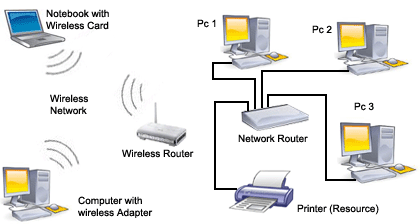
Above figure shows a simple network with three computers and a Printer. You can see that all devices are connected with network cables to a central network device called a Network Router. The printer in this network can be used by all the PCs. Also the figure show you how the Wireless network Works, the Notebook and the Computer connected with the wireless router by wireless adapters which equipped with them.
Network Stations: May be terminal, computers, telephones or other communication devices. They are also called HOST\END SYSTEMS. The hosts are connected to communication subnet or subnet. They carry messages from host and consist of switching elements and transmission lines. Transmission lines are also called CIRCUITS, CHANNELS, TRUNKS, move bits between the machines.
The switching elements are specialized computers used to connect two or more transmission lines. The purpose of the switching element is to choose outgoing line and forward the data arriving on an incoming line. All traffic to/from the host has to go via its IMP. They are also known as PACKET SWITCHING NODES, INTERMEDIATE SYSTEM OR DATA SWITCHING EXCHANGES.
Subnet is the collection of the communication lines and routers but not the host. The set of nods to which stations attached is the boundary of the communication network. The collection of routers and communication lines moves packets from source host to the destination host.
Network structure can be thought with
– Data terminal equipment (DTE).
– Data circuit terminating Equipment (DCE) concept.
Most digital data processing device have limited data transmission capacity and limited distance of data transmission. DTE is the end user machine, generally refers to (Devices) terminals and computers.
Example: Email terminal, workstation, ATM in a bank, sales terminal in a departmental store. They are not commonly connected directly to transmission medium.
DCE is used to connect the communication channel.
Example: modem. It interacts with DTE and provides an interface of DTE to communication network transmits and receive bits one at a time over the communication channel.
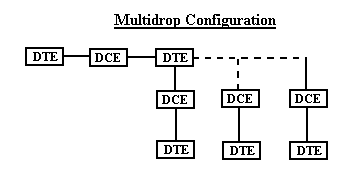
To specify the exact nature of interface between DTE and DCE various standards and protocols have been developed. DCEs and DTEs are connected in two ways. A high degree of cooperation is essential in DTE-DCE combination, as data and control information is to be exchanged. They can be connected in two ways
– Point to point configuration: Here only two DTE devices are in the channel
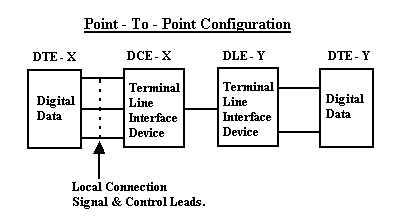
– Multidrop configuration: Here more than two devices are connected to the same communication channel.
This will provide the basic technology concepts required for understanding networking. The following are the lessons how we categorized Computer Network.