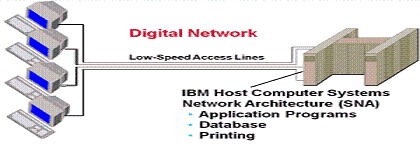
In the 1960’s and 1970’s, traditional computer communications centered around the mainframe host. The mainframe contained all the applications needed by the users, as well as file management, and even printing. This centralized computing environment used low-speed access lines that tied terminals to the host.
These large mainframes used digital signals – pulses of electricity or zeros and ones, what is called binary — to pass information from the terminals to the host. The information processing in the host was also all digital.
Problems faced in communication
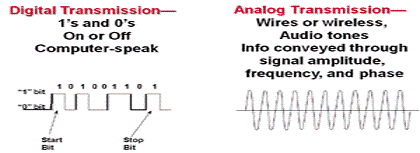
This brought about a problem. The telephone industry wanted to use computers to switch calls faster and the computer industry wanted to connect remote users to the mainframe using the telephone service. But the telephone networks speak analog and computers speak digital. Let’s take a closer look at this problem.
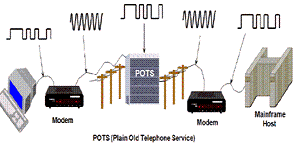
Digital signals are seen as one’s and zero’s. The signal is either on or off. Whereas analog signals are like audio tones – for example, the high-pitched squeal you hear when you accidentally call a fax machine. So, in order for the computer world to use the services of the telephone system, a conversion of the signal had to occur.
The solution
The solution – a modulator/demodulator or “modem.” The modem takes the digital signals from the computer and modulates the signal into analog format. In sending information from a desktop computer to a host using POTS or plain old telephone service, the modem takes the digital signals from the computer and modulates the signal into analog format to go through the telephone system. From the telephone system, the analog signal goes through another modem which converts the signal to digital format to be processed by the host computer.
This helped solve some of the distance problems, at least to a certain extent.
Multiplexing or muxing
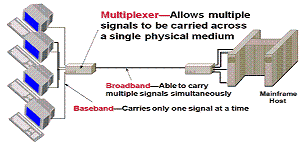
Another problem is how to connect multiple terminals to a single cable. The technology solution is multiplexing or muxing. What we can do with multiplexing is we can take multiple remote terminals, connect them back to our single central site, our single mainframe at the central site, but we can do it all over a single communications channel, a single line. So what you see is we have some new terminology here in our diagram. Our single central site we refer to as a broadband connection. That’s referred to as a broadband connection because whenever we talk about broadband we’re talking about carrying multiple communications channels over a single communication pipe. So what we’re saying here is we have multiple communication channels as in four terminals at the remote site going back to a single central site over one common channel. But again in the case of our definition of broadband here, we’re referring to the fact that we have four communication channels, one for each remote terminal over a single physical path. Now out at the end stations at the terminals, you see we have the term Baseband and what we mean by the term Baseband is, in our example, between the terminal and the multiplexer we have a single communication channel per wire, so each of those wires leading into the multiplexer has a dedicated channel or a dedicated path. Now the function of the multiplexer is to take each of those Baseband paths and break it up and allocate time slots. What that allows us to do is allocate a time slot per terminal so each terminal has its own time slot across that common Baseband connection between the remote terminals and the central mainframe site. That is the function of the multiplexer is to allocate the time slots and then also on the other side to put the pieces back together for delivery to the mainframe. So muxing is our fundamental concept here.
Let’s look at the different ways to do our muxing.
Baseband and broadband
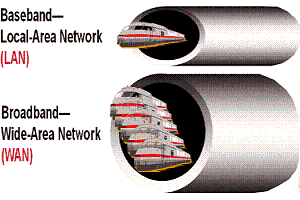
You see again the terms here, Baseband and broadband. Again, the analogy that they’re using here is that in the case of Baseband we said we had a single communications channel per physical path. An example of some Baseband technology you’re probably familiar with is Ethernet for example. Most implementations of Ethernet use Baseband technology.We have a single communications channel going over a single physical path or a single physical cable. On the other hand on the bottom part of our diagram you see a reference to broadband and the analogy here would be multiple trains inside of a single tunnel. Maybe we see that in the real world, we’re probably familiar with broadband as something we do every day, is cable TV. With cable TV we have multiple channels coming in over a single cable. We plug a single cable into the back of our TV and over that single cable certainly we know we can get 12 or 20 or 40 or 60 or more channels over that single cable. So cable TV is a good example of broadband.
Given the addition of multiplexing and the use of the modem, let’s see how we can grow our network.