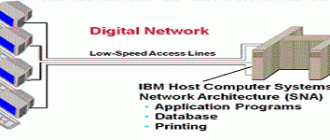
Super servers, high-capacity workstations, and multimedia applications have also fueled the need for higher capacity bandwidths.
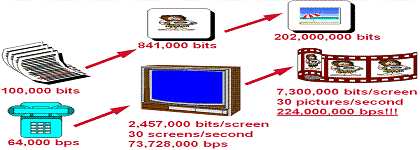
The examples on abow image shows that the need for throughput capacity grows as a result of a desire to transmit more voice, video, and graphics. The rate at which this information may be sent (transmission speed) is dependent how data is transmitted and the medium used for transmission. The “how” of this equation is satisfied by a transmission protocol.
Each protocol runs at a different speed. Two terms are used to describe this speed: throughput rate and bandwidth. The throughput rate is the rate of information arriving at, and possibly passing through, a particular point in a network. In this chapter, the term bandwidth means the total capacity of a given network medium (twisted pair, coaxial, or fiber-optic cable) or protocol.
– Bandwidth is also used to describe the difference between the highest and the lowest frequencies available for network signals. This quantity is measured in Megahertz (MHz).
– The bandwidth of a given network medium or protocol is measured in bits per second (bps).
Some of the available bandwidth specified for a given medium or protocol is used up in overhead, including control characters. This overhead reduces the capacity available for transmitting data.
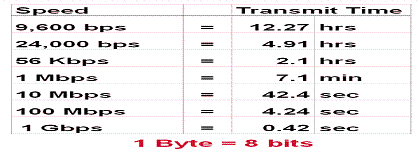
This table shows the tremendous variation in transmission time with different throughput rates. In years past, megabit (Mb) rates were considered fast. In today’s modern networks, gigabit (Gb) rates are possible. Nevertheless, there continues to be a focus on greater throughput rates.