Lesson
1: Networking Basic
Networking
History |
How a LAN Is Built | LAN
Topologies | LAN/WAN
Devices
LAN Topologies
You may hear the word topology used with
respect to networks. “Topology” refers to the
physical arrangement of network components and media within
an enterprise networking structure. There are four primary
kinds of LAN topologies: bus, tree, star, and ring.
Bus and Tree topology
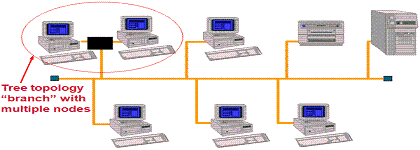
Bus topology is
- A linear LAN architecture in which transmissions
from network components propagate the length of the
medium and are received by all other components.
- The bus portion is the common physical signal
path composed of wires or other media across which
signals can be sent from one part of a network to another.
Sometimes called a highway.
- Ethernet/IEEE 802.3 networks commonly implement
a bus topology
Tree topology is
- Similar to bus topology, except that tree networks
can contain branches with multiple nodes. As in
bus topology, transmissions from one component propagate the
length of the medium and are received by
all other components.
The disadvantage of bus topology is that if the connection
to any one user is broken, the entire network goes down, disrupting
communication between all users. Because of this problem,
bus topology is rarely used today.
The advantage of bus topology is that it requires less cabling
(therefore, lower cost) than star topology.
Star topology
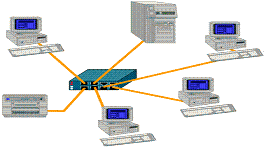
Star topology is a LAN topology in which
endpoints on a network are connected to a common central switch
or hub by point-to-point links. Logical bus and ring topologies
re often implemented physically in a star topology.
- The benefit of star topology is that even if
the connection to any one user is broken, the network stays
functioning, and communication between the remaining users
is not disrupted.
- The disadvantage of star topology is that it
requires more cabling (therefore, higher cost) than bus
topology.
Star topology may be thought of as a bus in a box.
Ring topology
Ring topology consists of a series of repeaters
connected to one another by unidirectional transmission links
to form a single closed loop.
- Each station on the network connects to the network
at a repeater.
- While logically a ring, ring topologies are most
often organized in a closed-loop star. A ring topology
that is organized as a star implements a unidirectional closed-loop
star, instead of point-to-point links.
- One example of a ring topology is Token Ring.
Redundancy is used to avoid collapse of the entire ring in
the event that a connection between two components fails.
<<Back
[1] [2]
[3]
[4] [5]
[6] [7]
[8] Next>>
|