
Simply defined, a VPN is an enterprise network deployed on a shared infrastructure employing the same security, management, and throughput policies applied in a private network.
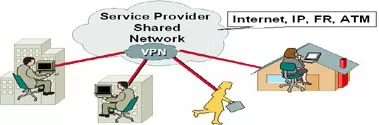
A VPN can be built on the Internet or on a service provider’s IP, Frame Relay, or ATM infrastructure. Businesses that run their intranets over a VPN service enjoy the same security, QoS, reliability, and scalability as they do in their own private networks.
VPNs based on IP can naturally extend the ubiquitous nature of intranets over wide-area links, to remote offices, mobile users, and telecommuters. Further, they can support extranets linking business partners, customers, and suppliers to provide better customer satisfaction and reduced manufacturing costs. Alternatively, VPNs can connect communities of interest, providing a secure forum for common topics of discussion.
Virtual Private Networks
Building a virtual private network means you use the “public” Internet (or a service provider’s network) as your “private” wide-area network.

Since it’s generally much less expensive to connect to the Internet than to lease your own data circuits, a VPN may allow to you connect remote offices or employees who wouldn’t ordinarily justify the cost of a regular WAN connection.
VPNs may be useful for conducting secure transactions, or transferring highly confidential data between offices that have a WAN connection.
Some of the technologies that make VPNs possible are:
- – Tunneling
- – Encryption
- – QoS
- – Comprehensive security
Why Build a VPN?
Why should customers consider a VPN?
– Company information is secured
-VPNs allow vital company information to be secure against unwanted intrusion
– Reduce costs
– Internet-based VPNs offer low-cost connectivity from anywhere in the world, and can be considered a viable replacement for leased-line or Frame Relay services
Using the Internet as a replacement for expensive WAN services can cut costs by as much as 60 percent, according to Forrester Research
– Also lower remote costs by connecting a mobile user over the Internet. (Often referred to as a virtual private dial-up networking, or VPDN).
– Wider connectivity options for users
– A VPN can provide more connectivity options (for example, over cable, DSL, telephone, or Ethernet)
– Increased speed of deployment
– Extranets can be created more easily (you don’t wait for suppliers). This keeps the customer in control of their own destiny.
However, for an Internet-based VPN to be considered as a viable replacement for leased-line or Frame Relay service, it must be able to offer a comparable level of security, quality of service, and reliability.