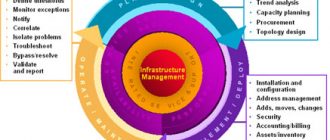
Traditional Management Model Can’t Keep Pace
Here are the reasons, Why the Traditional Management Model can not keep pace when the management Intranet Basics
- – Focused point products
- – Hierarchical platforms
- – Minimal integration
- – Proprietary solutions and APIs
- – Product conflicts—What works with what?
New Model of Integration— Management Intranet
Multiple Web-accessible management tools can be hyperlinked, and management information shared easily with the DMTF’s Common Information Model (CIM) standard. Cisco’s approach to Web-based enterprise management goes beyond mere browser access to embrace the total rearchitecting and reengineering of its management products as true network-based applications. It also includes leadership in creation and adoption of standards such as CIM for multivendor management data integration. Cisco is aggressively applying Internet technologies and standards to create comprehensive enterprise management that easily integrates with leading third-party tools and enterprise system and service management frameworks through the Cisco Management Connection.
CIM Data Exchange
For the Web model to deliver substantial value for the management software industry, however, the vendors must agree on content standards for sharing of management information. Such a set of Web-oriented standards for exchanging basic management information is being defined under the Web-Based Enterprise Management (WBEM) initiative, spearheaded by vendors such as Cisco, HP, Intel, Compaq, BMC, Microsoft, IBM/Tivoli and others. The Desktop Management Task Force (DMTF) is now leading the effort to standardize the technologies of WBEM. The first of these, the CIM provides an extensible data model of the enterprise computing environment. Recent work by the DMTF makes the CIM model the basis for Web-based integration using XML (see sidebar on Web-Based Enterprise Management Standards for details).
Under the emerging Web-based management architecture, separate tools and management applications can be integrated via a common browser interface that supports hyperlinking and the exchange of management data via CIM. Leading vendors, including Microsoft, Computer Associates, IBM/Tivoli, and Cisco have announced or released products that implement the early versions of CIM standards. Already, Cisco and IBM/Tivoli have demonstrated use of CIM for two-way device data exchange between their management software packages. In addition to CIM-based data exchange, tools can be hyperlinked to provide easy shifting within the browser from tool to tool as an operator executes a task such as isolating and solving a problem. In this way, the most basic launch-level integration, popular for many years in existing management platforms, becomes available with minimal effort for practically any tool. Cisco is exploiting this technique to link its growing body of management tools and distributed management data collection infrastructure with third-party ISV packages. It already has available Web-linking to more than 30 leading third-party applications and is making it easy for its customers to create a “management intranet”
Role of Directories
- – Single-user identity
- – User profiles, applications, and network services
- – Integrated policies
- – Common information model
Directory Enabled Networks (DEN) Standards
The future of the Directory Enabled Network is to extend the directory throughout the elements of the network.
We can then provide a unified view of all the network resources at our disposal. From a user perspective, you’ll not need to be authenticated on a half a dozen different devices just to get your job done.