– Application Layer
If we take a look at the model from the top layer, the Application Layer, down, I think you will begin to get a better idea of what the model does for the industry.
The applications that you run on a desktop system, such as Power Point, Excel and Word work above the seven layers of the model.
The application layer of the model helps to provide network services to the applications. Some of the application processes or services that it offers are electronic mail, file transfer, and terminal emulation.
– Presentation Layer
The next layer of the seven layer model is the presentation layer. It is responsible for the overall representation of the data from the application layer to the receiving system. It insures that the data is readable by the receiving system.
– Session Layer
The session layer is concerned with inter-host communication. It establishes, manages and terminates sessions between applications.
– Trasport Layer
Layer 4, the Transport layer is primarily concerned with end-to-end connection reliability. It is concerned with issues such as data transport information flow and fault detection and the recovery.
– Network Layer
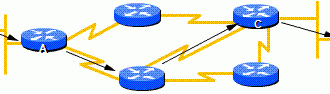
The network layer is layer 3. This is the layer that is associated with addressing and looking for the best path to send information on. It provides connectivity and path selection between two systems.
The network layer is essentially the domain of routing. So when we talk about a device having layer 3 capability, we mean that that device is capable of addressing and best path selection.
– Data Link Layer
The link layer (formally referred to as the data link layer) provides reliable transit of data across a physical link. In so doing, the link layer is concerned with physical (as opposed to network or logical) addressing, network topology, line discipline (how end systems will use the network link), error notification, ordered delivery of frames, and flow control.
– Physical Layer
The physical layer is concerned with binary transmission. It defines the electrical, mechanical, procedural, and functional specifications for activating, maintaining, and deactivating the physical link between end systems. Such characteristics as voltage levels, physical data rates, and physical connectors are defined by physical layer specifications. Now you know the role of all 7 layers of the OSI model.