
Network Layer Protocol Operations
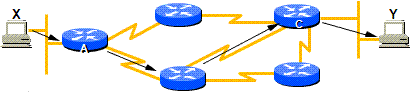
Let’s take a look at the flow of packets through a routed network. For examples sake, let’s say it is an Email message from you at Station X to your mother in Michigan who is using System Y. The message will exit Station X and travel through the corporate internal network until it gets to a point where it needs the services of an Internet service provider. The message will bounce through their network and eventually arrive at Mom’s Internet provider in Dearborn. Now, we have simplified this transmission to three routers, when in actuality, it could travel through many different networks before it arrives at its destination.
Let’s take a look, from the OSI models reference point, at what is happening to the message as it bounces around the Internet on its way to Mom’s.
As information travels from Station X it reaches the network level where a network address is added to the packet. At the data link layer, the information is encapsulated in an Ethernet frame. Then it goes to the router – here it is Router A – and the router de-encapsulates and examines the frame to determine what type of network layer data is being carried. The network layer data is sent to the appropriate network layer process, and the frame itself is discarded.
The network layer process examines the header to determine the destination network. The packet is again encapsulated in the data-link frame for the selected interface and queued for delivery. This process occurs each time the packet switches through another router. At the router connected to the network containing the destination host – in this case, C — the packet is again encapsulated in the destination LAN’s data-link frame type for delivery to the protocol stack on the destination host, System Y.
Multiprotocol Routing
Routers are capable of understanding address information coming from many different types of networks and maintaining associated routing tables for several routed protocols concurrently. This capability allows a router to interleave packets from several routed protocols over the same data links. As the router receives packets from the users on the networks using IP, it builds a routing table containing the addresses of the network of these IP users.
Now some Macintosh AppleTalk users are adding to the traffic on this link of the network. The router adds the AppleTalk addresses to the routing table. Routing tables can contain address information from multiple protocol networks. In addition to the AppleTalk and IP users, there is also some IPX traffic from some Novell NetWare networks.
Finally, we see some DEC traffic from the VAX minicomputers attached to the Ethernet networks. Routers can pass traffic from these (and other) protocols across the common Internet. The various routed protocols operate separately. Each uses routing tables to determine paths and switches over addressed ports in a “ships in the night” fashion; that is, each protocol operates without knowledge of or coordination with any of the other protocol operations. Now, we have spent some time with routed protocols;
let’s take some time talking about routing protocols.
Routed Versus Routing Protocol
It is easy to confuse the similar terms routed protocol and routing protocol:
Routed protocols are what we have been talking about so far. They are any network protocol suite that provides enough information in its network layer address to allow a packet to direct user traffic. Routed protocols define the format and use of the fields within a packet. Packets generally are conveyed from end system to end system. The Internet protocol IP and Novell’s IPX are examples of routed protocols.
Routing protocol support a routed protocol by providing mechanisms for sharing routing information. Routing protocol messages move between the routers. A routing protocol allows the routers to communicate with other routers to update and maintain tables. Routing protocol messages do not carry end-user traffic from network to network. A routing protocol uses the routed protocol to pass information between routers. TCP/IP examples of routing protocols are Routing Information Protocol (RIP), Interior Gateway Routing Protocol (IGRP), and Open Shortest Path First (OSPF).