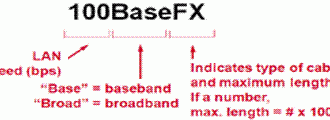
- – Fast Ethernet
- – Fast EtherChannel®
- – Gigabit Ethernet
- – Gigabit EtherChannel
We’ve mentioned that Ethernet also has high speed options that are currently available. Fast Ethernet is used widely at this point and provides customers with 100 Mbps performance, a ten-fold increase. Fast EtherChannel is a Cisco value-added feature that provides bandwidth up to 800 Mbps. There is now a standard for Gigabit Ethernet as well and Cisco provides Gigabit Ethernet solutions with 1000 Mbps performance.
Let’s look more closely at Fast EtherChannel and Gigabit Ethernet.
What Is Fast EtherChannel?
Grouping of multiple Fast Ethernet interfaces into one logical transmission path
- – Scalable bandwidth up to 800+ Mbps
- – Using industry-standard Fast Ethernet
- – Load balancing across parallel links
- – Extendable to Gigabit Ethernet
Fast EtherChannel provides a solution for network managers who require higher bandwidth between servers, routers, and switches than Fast Ethernet technology can currently provide.
Fast EtherChannel is the grouping of multiple Fast Ethernet interfaces into one logical transmission path providing parallel bandwidth between switches, servers, and Cisco routers. Fast EtherChannel provides bandwidth aggregation by combining parallel 100-Mbps Ethernet links (200-Mbps full-duplex) to provide flexible, incremental bandwidth between network devices.
For example, network managers can deploy Fast EtherChannel consisting of pairs of full-duplex Fast Ethernet to provide 400+ Mbps between the wiring closet and the data center, while in the data center bandwidths of up to 800 Mbps can be provided between servers and the network backbone to provide large amounts of scalable incremental bandwidth.
Cisco’s Fast EtherChannel technology builds upon standards-based 802.3 full-duplex Fast Ethernet. It is supported by industry leaders such as Adaptec, Compaq, Hewlett-Packard, Intel, Micron, Silicon Graphics, Sun Microsystems, and Xircom and is scalable to Gigabit Ethernet in the future.
What Is Gigabit Ethernet?
In some cases, Fast EtherChannel technology may not be enough.
The old 80/20 rule of network traffic (80 percent of traffic was local, 20 percent was over the backbone) has been inverted by intranets and the World Wide Web. The rule of thumb today is to plan for 80 percent of the traffic going over the backbone.
Gigabit networking is important to accommodate these evolving needs.
Gigabit Ethernet builds on the Ethernet protocol but increases speed tenfold over Fast Ethernet, to 1000 Mbps, or 1 Gbps. It promises to be a dominant player in high-speed LAN backbones and server connectivity. Because Gigabit Ethernet significantly leverages on Ethernet, network managers will be able to leverage their existing knowledge base to manage and maintain Gigabit networks.
The Gigabit Ethernet spec addresses three forms of transmission media though not all are available yet:
- – 1000BaseLX: Long-wave (LW) laser over single-mode and multimode fiber
- – 1000BaseSX: Short-wave (SW) laser over multimode fiber
- – 1000BaseCX: Transmission over balanced shielded 150-ohm 2-pair STP copper cable
- – 1000BaseT: Category 5 UTP copper wiring Gigabit Ethernet allows Ethernet to scale from 10 Mbps at the desktop, to 100 Mbps to the workgroup, to 1000 Mbps in the data center. By leveraging the current Ethernet standards as well as the installed base of Ethernet and Fast Ethernet switches and routers, network managers do not need to retrain and relearn a new technology to provide support for Gigabit Ethernet.