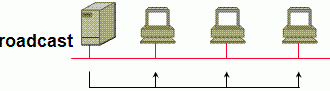
This also needs to be done dynamically because these multicast groups are going to change over time at any given moment. So, in order to do this, we need some special protocols in our network. First of all, in the Wide Area, we need something known as multicast routing protocols.Certainly, in our
Wide Area we already have routing protocols such as RIP, the Routing Information Protocol, or OSPF, or IGRP, for example, but what we need to do is add multicast extensions so that these routing protocols need, understand how to handle the need for our multicast groups.
An example of a multicast routing protocol would be PIM, or Protocol Independent multicasting, for example. This is simply an extension of the existing routing protocols in our network.Another protocol we have is known as IGMP, or the Internet Group Management Protocol. And IGMP simply allows us to identify the group membership of the IP stations that want to participate in a given multicast conversation.
So as you can see indicated by the red traffic in our network, we have channel #1 being multicast through the network. And by way of IGMP, the workstations can signal back to the original video servers that they want to participate.And by way of the multicast routing protocols are added, we can efficiently deliver our traffic in the Wide Area.Now, another challenge that we have is once our traffic gets to the Local Area Network, or the switch, by default that traffic is going to be flooded to all stations in the network.
End-to-End Multicast
And that’s because IGMP works at Layer 3,, but our LAN switch works at Layer 2. So the switch has no concept of our Layer 3 group membership. So what we need to do is add some intelligence to our switch.The intelligence that going to add is a protocol such as CGMP, for example, or Cisco Group Management Protocol. Another similar technology that we could add, is called IGMP Snooping, which has the same effect in the Local Area Network.
And that effect is, as you see in the diagram, to limit our multicast traffic to only those stations that want to participate in the group. So now, as you can see, the red channel, or channel number 1, is delivered to only station #1 and station #3.
The station 2 does not receive this content because he doesn’t wish to participate.So the advantage of adding protocols such as IGMP, CGMP, IGMP Snooping, and Protocol Independent multicasting into our network, that achieved bandwidth savings for our multicast traffic.
Why Use Multicast?
What we see indicated in the red is, as we add stations to our multicast group, the amount of bandwidth we need to do that is going to increase in a linear fashion.But by adding multicast controls, you can see the amount of bandwidth is reduced dramatically. Because these intelligent multicast controls can better make, can make better use of the bandwidth in our network.So by adding multicast controls that’s going to also reduce the cost of networking as well because we’ve reduced the bandwidth that we need, so that’s going to provide a dramatic improvement to our Local Area Network.
– Summary –
- Switches provide dedicated access
- Switches eliminate collisions and increase capacity
- Switches support multiple conversations at the same time
- Switches provide intelligence for multicasting