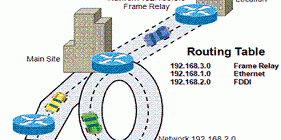
This illustrates the flow of packets through a routed network using the example of an e-mail message being sent from system X to system Y. The message exits system X and travel through an organization’s internal network until it gets to a point where it needs an Internet service provider.
The message will bounce through their network and eventually arrive at system Y’s internet provider. While this example shows three routers, the message could actually travel through many different networks before it arrives at its destination. From the OSI model reference point of view, when the e-mail is converted into packets and sent to a different network, a data-link frame is received on one of a router’s interfaces.
- – The router de-encapsulates and examines the frame to determine what type of network layer data is being carried. The network layer data is sent to the appropriate network layer process, and the frame itself is discarded.
- – The network layer process examines the header to determine the destination network and then references the routing table that associates networks to outgoing interfaces.
- – The packet is again encapsulated in the link frame for the selected interface and sent on.
This process occurs each time the packet transfers to another router. At the router connected to the network containing the destination host, the packet is encapsulated in the destination LAN’s data-link frame type for delivery to the protocol stack on the destination host.
Path Determination
Routing involves two basic activities: determining optimal routing paths and transporting information groups (typically called packets) through an internetwork. In the context of the routing process, the latter of these is referred to as switching. Although switching is relatively straightforward, path determination can be very complex.
During path determination, routers evaluate the available paths to a destination and to establish the preferred handling of a packet.
– Routing services use internetwork topology information (such as metrics) when evaluating network paths. This information can be configured by the network administrator or collected through dynamic processes running in the internetwork.
– After the router determines which path to use, it can proceed with switching the packet: Taking the packet it accepted on one interface and forwarding it to another interface or port that reflects the best path to the packet’s destination.
Multiprotocol Routing
Routers can support multiple independent routing algorithms and maintain associated routing tables for several routed protocols concurrently. This capability allows a router to interleave packets from several routed protocols over the same data links.
The various routed protocols operate separately. Each uses routing tables to determine paths and switches over addressed ports in a “ships in the night” fashion; that is, each protocol operates without knowledge of or coordination with any of the other protocol operations.
In the example above, as the router receives packets from the users on the networks using IP, it begins to build a routing table containing the addresses of the network of these IP users. As the router receives packets from Macintosh AppleTalk users. Again, the router adds the AppleTalk addresses. Routing tables can contain address information from multiple protocol networks. This process may continue with IPX traffic from Novell NetWare networks and Digital traffic from VAX minicomputers attached to Ethernet networks.