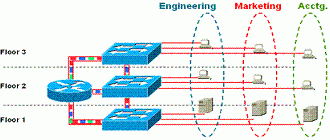
VLANs provide many internetworking benefits that are compelling. Reduced administrative costs—Members of a VLAN group can be geographically dispersed. Members might be related because of their job functions or type of data that they use rather than the physical location of their workspace.
– The power of VLANs comes from the fact that adds, moves, and changes can be achieved simply by configuring a port into the appropriate VLAN. Expensive, time-consuming recabling to extend connectivity in a switched LAN environment, or host reconfiguration and re-addressing is no longer necessary, because network management can be used to logically “drag and drop” a user from one VLAN group to another.
Better management and control of broadcast activity—A VLAN solves the scalability problems often found in a large flat network by breaking a single broadcast domain into several smaller broadcast domains or VLAN groups. All broadcast and multicast traffic is contained within each smaller domain.
Tighter network security with establishment of secure user groups:
– High-security users can be placed in a separate VLAN group so that non-group members do not receive their broadcasts and cannot communicate with them.
– If inter-VLAN communication is necessary, a router can be added, and the traditional security and filtering functions of a router can be used.
– Workgroup servers can be relocated into secured, centralized locations.
Scalability and performance—VLAN groups can be defined based on any criteria; therefore, you can determine a network’s traffic patterns and associate users and resources logically. For example, an engineer making intensive use of a networked CAD/CAM server can be put into a separate VLAN group containing just the engineer and the server. The engineer does not affect the rest of the workgroup. The engineer’s dedicated LAN increases throughput to the CAD/CAM server and helps performance for the rest of the group by not affecting its work.
VLAN Components
There are five key components within VLANs:
Switches — For determining VLAN membership. This is where users/systems attach to the network.
Trunking — For exchanging VLAN information throughout the network. This is essential for larger environments that comprise several switches, routers, and servers.
Multiprotocol routing — For supporting inter-VLAN communications. Remember that while all members within the same VLAN can communicate directly with one another, routers are required for exchanging information between different VLANs.
Servers — Servers are not required within VLAN environments specifically; however, they are a staple within any network. Within a VLAN environment, users can utilize servers in several different ways, and we’ll discuss them momentarily. Because VLANs are used throughout the network, users from multiple VLANs will most likely need their services.
Management — For security, control, and administration within the network. Effective management and administration is essential within any network environment, and it becomes even more imperative for networks using VLANs. The network management system appropriately recognize and administer logical segments within the switched network.
Let’s look at some of these components in more detail.
Establishing VLAN Membership
Switches provide the means for users to access a network and join a VLAN. Various approaches exist for establishing VLAN membership.
each of these methods has its positive and negative points.